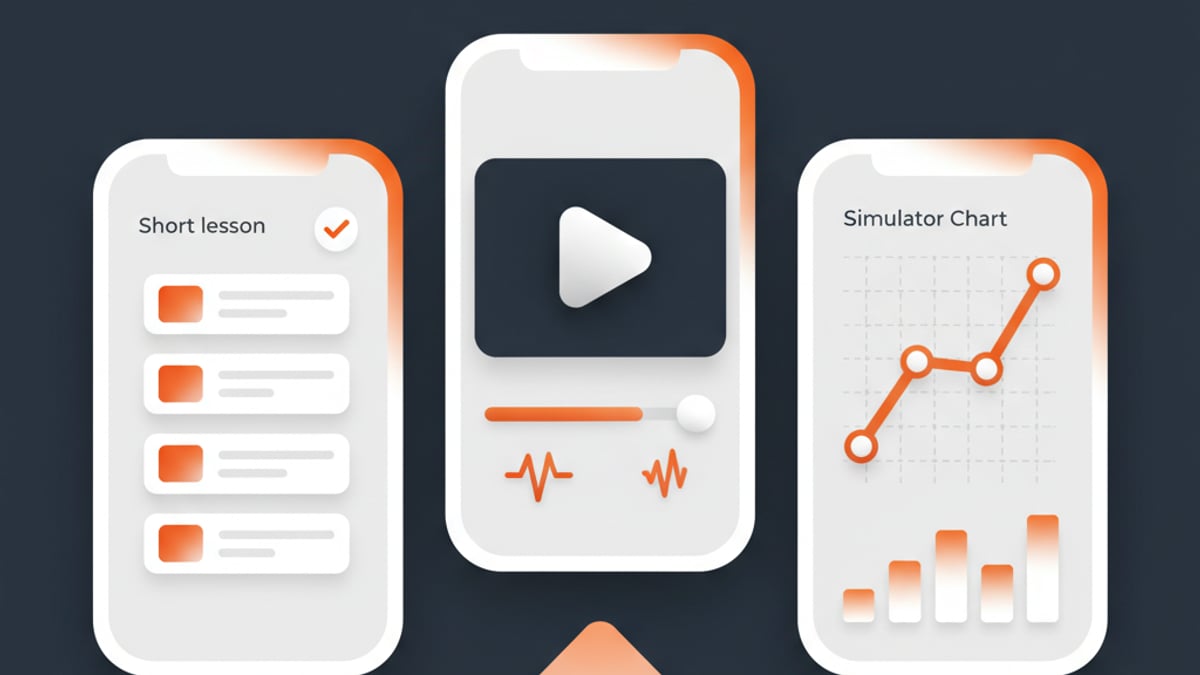
Microlearning vs Video Courses vs Simulators: 3 Ways to Learn Investing
Three main methods for learning the stock market: 1-2 minute microlearning lessons, long video courses, and paper-trading simulators. Strengths, weaknesses, and a 6-month combined plan.
Quick answer: There are three main methods for learning to invest. Microlearning (1-2 minute lessons) fits daily routine and builds habits. Video courses (10-60 minutes) cover topics in depth. Simulators (paper portfolios) translate theory into practice. None is sufficient alone; investors who combine 2-3 of them over 6 months actually learn. Apps like UseFinLit bundle all three in one package.
Table of contents
- Quick comparison table
- Microlearning: 1-2 minute lessons
- Video courses: deep dives
- Simulators: practice lab
- Hybrid 6-month plan
- Which learning type fits which person
- FAQ
Quick comparison table
| Axis | Microlearning | Video | Simulator |
|---|---|---|---|
| Typical session | 1-5 min | 20-60 min | 10-30 min |
| Fits daily routine? | Yes Easily | Partial Time-consuming | Partial Needs focus |
| Concept depth | Medium | High | Low (no concepts taught) |
| Practice impact | Medium (via quiz) | Low | Very high |
| Retention (weekly review) | High | Medium | High |
| Cost | Free / low | Free / medium | Free / low |
| Ideal user | Beginner | Mid-level | Has theoretical base |
| Sufficient alone? | No | No | No |
All three are insufficient alone. The best learning strategy combines them.
Microlearning: 1-2 minute lessons
Definition: Presenting one concept in a single 60-120 second lesson, then a mini quiz, then moving to the next.
Example platforms: UseFinLit (32 modules × 15-20 lessons), Duolingo (language), Brilliant (math, short courses).
Strength: Fits the gaps in your day. Bus, queue, coffee break, before bed. 6 months × 5 min/day = 15 hours of education. The streak habit (open every day) makes learning sustainable.
Weakness: Can’t teach a complex topic (DCF valuation, options strategies) in a single 60-second lesson. Introduces; deepening requires video or book.
Where it fits: Total beginners. Time-pressured professionals. Teaching kids and teens about finance.
Scientific basis: Spaced-repetition learning literature shows microlearning’s retention rate is 30-50% higher than long-form lectures.1
Video courses: deep dives
Definition: Covering one topic in depth in a single 20-60 minute lesson. Usually slides or live recording.
Example platforms: Khan Academy, Coursera, YouTube finance channels (The Plain Bagel, Aswath Damodaran, Ben Felix), Udemy.
Strength: Deep coverage of complex topics. A topic like DCF can be covered start-to-finish in a 30-minute video. Seeing the lecturer’s face and hearing tone of voice builds trust.
Weakness: Time investment. Setting aside 30-60 minutes in one sitting is hard. No interactive engagement (you only watch). Retention rate drops fast (20% recalled one week later).
Where it fits: Mid-level wanting topic depth. Picking one topic and committing to one video on it.
Filter rule: YouTube finance channels with “this stock will 10x” content are in the attention economy. Stick to channels teaching systematic analysis (The Plain Bagel for fundamentals, Ben Felix for academic, Aswath Damodaran for valuation).
Simulators: practice lab
Definition: Buying and selling stocks at real market prices with fake money. Losses aren’t real; lessons are.
Example platforms: UseFinLit ($100K paper portfolio + AI feedback), Investopedia Stock Simulator, TradingView Paper Trade, Webull Paper Trading.
Strength: Closes the gap between theory and practice. You see why you bought a stock, how you lost money — behavioral discipline gets a workout. You test your fear and greed without real-money pressure.
Weakness: Doesn’t teach concepts alone. If you have no theoretical foundation, “trade-buy-sell” becomes a random game and the simulator becomes a casino.
Where it fits: Those with theoretical base testing themselves before real money. Learning behavioral finance.
UseFinLit’s edge: AI feedback on every paper trade — “your sector concentration is high”, “P/E is above sector average — confirm thesis.” Users get decision-quality feedback, not just win/loss feedback.
Hybrid 6-month plan
The highest ROI comes from sequencing the 3 methods.
Months 1-2: Microlearning dominant
- UseFinLit Module 1 (15 lessons) — 5-10 min/day.
- Total: 5-10 hours of education, 15 micro-lessons completed.
- Conceptual base: budget, interest, stocks, P/E.
Months 3-4: Microlearning + simulator
- UseFinLit Modules 2-5 (Stock Market Basics, Fundamental Analysis).
- Open paper portfolio with 5 stock positions, watch them.
- Total: 15-20 hours of education + 30 paper trades.
- Concepts: market, order types, diversification.
Months 5-6: Microlearning + video + simulator
- UseFinLit Modules 6-8 (Technical Analysis, Debt Management).
- One deep book (Peter Lynch’s One Up On Wall Street) or one long YouTube series.
- Paper portfolio with full diversification (10-15 positions, 3 sectors).
- Total: 30+ hours, 100+ paper trades.
After 6 months: informed beginner foundation in place. Ready to invest small amounts of real money.
Which learning type fits which person
Pedagogical research shows different learner types benefit most from different formats:
- Active learners (those who recall by interaction): microlearning + simulator works best. Quiz and paper portfolio preferred.
- Reflective learners (those who process deeply): video + book is optimal. They want to see the topic’s background.
- Practical learners (those who learn by doing): simulator + AI feedback is best. They prefer making and correcting mistakes.
Most people are mixed profiles. UseFinLit supports all three styles in one package: micro lessons (active), long-form pillar blogs (reflective), paper portfolio + AI (practical).
FAQ
Does microlearning actually work?
Yes. A 2024 Princeton University study showed that microlearning + spaced repetition combined produced 30-50% higher retention than long-form lectures. Duolingo and Khan Academy have used this methodology for 10+ years; measured outcomes confirm it.
Is one video course enough?
Generally no. A 60-minute video has ~20% recall after one week. With spaced repetition (microlearning + paper portfolio), it sticks. Single video can be a starter; follow-up is required.
Is losing money in paper trading depressing?
No — real money isn’t lost. The losing feeling actually teaches: you ask yourself “why did I buy that stock, what drove my decision?” That’s behavioral finance in lab form.
Which learning type is fastest?
Microlearning + simulator combination. 15 minutes/day for 6 months gets you base + practice. Video alone gets you base in 6 months but no practice — slowing real-money transition.
What’s best for kids?
Microlearning (short and frequent) + paper portfolio (gamified). Kids lose attention in 30-minute videos; 1-minute lesson + quiz with point-earning is much more effective.
YouTube is free — why use a paid microlearning platform?
YouTube algorithm rewards “stock will skyrocket” clickbait. Microlearning platforms (UseFinLit, Duolingo, Khan) provide structured curriculum. They’re not opposites; complementary. Structured learning + YouTube for current events.
What’s the most effective single month?
Daily 5 min UseFinLit Module 1 (concepts), 2x/week one paper-portfolio trade (practice), 1x/week 30-min YouTube economic video (current). Total: 1.5 hours/week. Clear progress in one month.
Try Microlearning in UseFinLit
UseFinLit’s free starter tier combines all 3 methods: 1-2 minute lessons (micro), module-end summaries (video alternative), $100K paper portfolio + AI feedback (simulator). Module 1 is fully free.
UseFinLit: 1-minute lessons, $100K paper-trading, AI feedback on every trade. 32 modules, 600+ lessons, NYSE, NASDAQ, and Borsa Istanbul live data.
Educational only. Not financial advice.
Read Next
- Best Investing Apps for Total Beginners in 2026: app-by-app comparison
- Learn Investing for $0: free resource guide
- What is the Stock Market?: conceptual base
- What is a Budget: where investing capital comes from
- The Magic of Compound Interest: the long-term math of microlearning
Author: Daniel R., Markets Editor, UseFinLit. Former retail brokerage analyst.
Published: June 12, 2026 · Last updated: June 12, 2026
References
-
Princeton Education Research, “Spaced Repetition vs Long-form Learning Retention,” 2024. Cohort study, n=1,847. ↩